
1. For multi-layer composite materials with vastly different hardness including copper foil, prepreg resin, glass fiber cloth and solder mask ink, ion beam polishing completely eliminates defects caused by mechanical grinding such as copper foil smearing, resin shedding, glass fiber pull-out and interfacial delamination. It delivers authentic cross-sections where all material layers retain their original bonding state, enabling accurate measurement of lamination structure consistency, dielectric layer thickness and copper foil profile.
- 基础参数
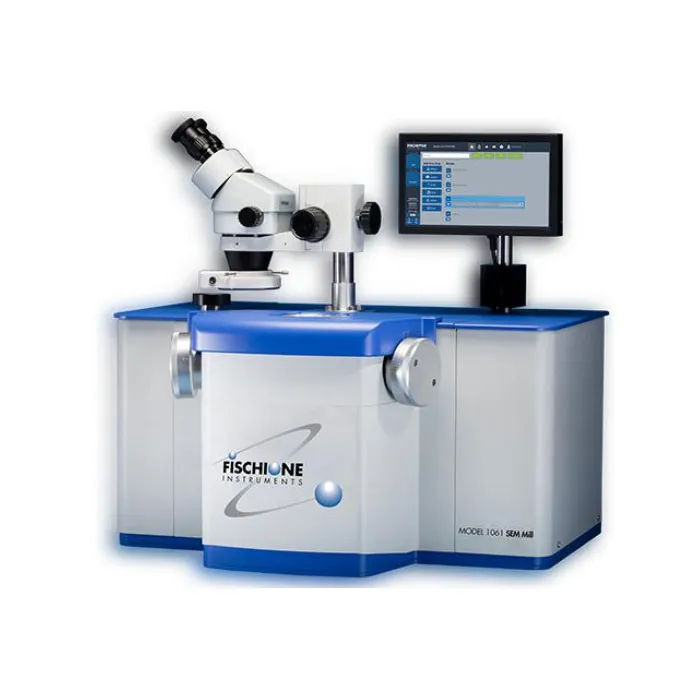
1. Equipped with two independently adjustable electromagnetic focused ion guns, each supporting separate setting of acceleration voltage and beam current parameters. One gun performs rapid trimming at high energy while the other delivers fine polishing at low energy. There is no need to repeatedly adjust parameters or switch ion sources during processing, improving the efficiency and consistency of cross-section preparation.
2. The acceleration voltage covers an ultra-wide range from 100 eV to 10 kV, and the ion beam spot maintains an optimized fine size at all voltage levels. The system can rapidly remove material and expose cross-sections at high voltage, while low voltage enables delicate surface finishing to minimize amorphous layers and ion damage, revealing genuine intrinsic microstructures.
3. Each ion gun is fitted with a dedicated Faraday cup for direct ion beam current detection. Beam calibration and verification can be completed prior to formal processing, ensuring comparable results across different specimens and operators.
4. A 10-inch angle-adjustable touchscreen control system features an intuitive layout with streamlined access to frequently used functions. New operators unfamiliar with ion beam equipment can master operation quickly, cutting training time.
5. Supplied with cross-section cutting holders and positioning fixtures. Combined with sample thickness measurement via magnetic encoders, the system automatically calculates the optimal polishing position, eliminating time-consuming manual alignment and ensuring repeatable polishing conditions for consistent results.
6. The polishing angle is continuously adjustable from 0° to +10°, accommodating cross-section angle and depth preparation requirements of diverse samples. Both flat cross-sections and slightly inclined cross-sections can be fabricated on a single unit.
7. In-situ real-time observation and recording of the entire polishing process are supported. Operators can monitor cross-section progress during processing to avoid over-polishing or incomplete milling caused by delayed feedback, and key process steps can be traced and reviewed for analysis.