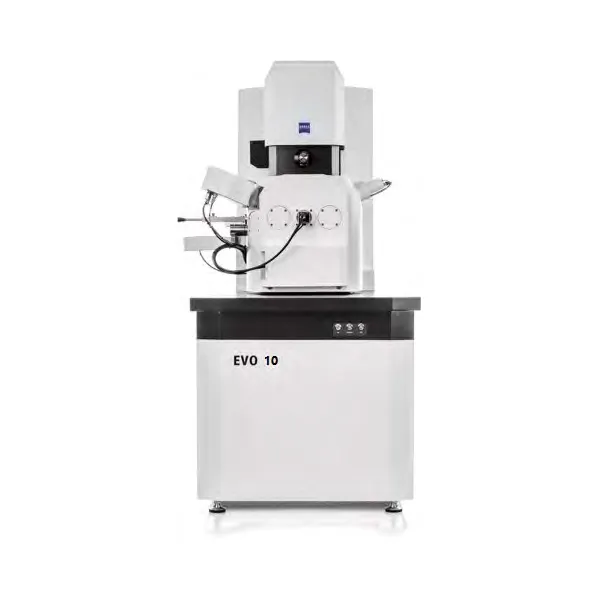
1. The 5-axis motorized sample stage (X, Y, Z, tilt and rotation) can be controlled via mouse, optional joystick or control panel. It electrically performs translation, tilting and rotation to easily position irregularly shaped samples. Compared with manual stages, it saves labor and cuts down time wasted on repeated manual resetting.
2. Image acquisition supports a maximum storage resolution of 32,000×24,000 pixels. Signal superposition via frame averaging (scan speed set to 2 or higher) is available. This acquisition method suppresses random noise at routine observation scan speeds, delivering cleaner image backgrounds and clearer fine details.
3. Probe current is continuously or stepwise adjustable from 0.5 pA to 5 μA, covering the full current range for both low-beam high-resolution morphological imaging and high-beam compositional analysis such as energy-dispersive spectroscopy and electron backscatter diffraction. A single instrument accommodates both morphological and compositional analysis modes without frequent parameter reconfiguration.
4. The sample chamber features an inner diameter of 310 mm and height of 220 mm, accepting samples up to 200 mm in diameter and 100 mm in height. Medium and small metal parts, large bearings and bulk materials can be loaded intact for observation, avoiding damage from cutting and preserving the original workpiece structure.
5. The motorized stage provides travel ranges of X: 80 mm, Y: 100 mm, Z: 35 mm. The rigid stage platform supports heavy specimens like large bearings. Spacers can be added or removed to fit samples of varying heights. The tilt and rotation module on the Z-axis is detachable; removing it extends the usable X and Y travel for flat samples with large horizontal dimensions.